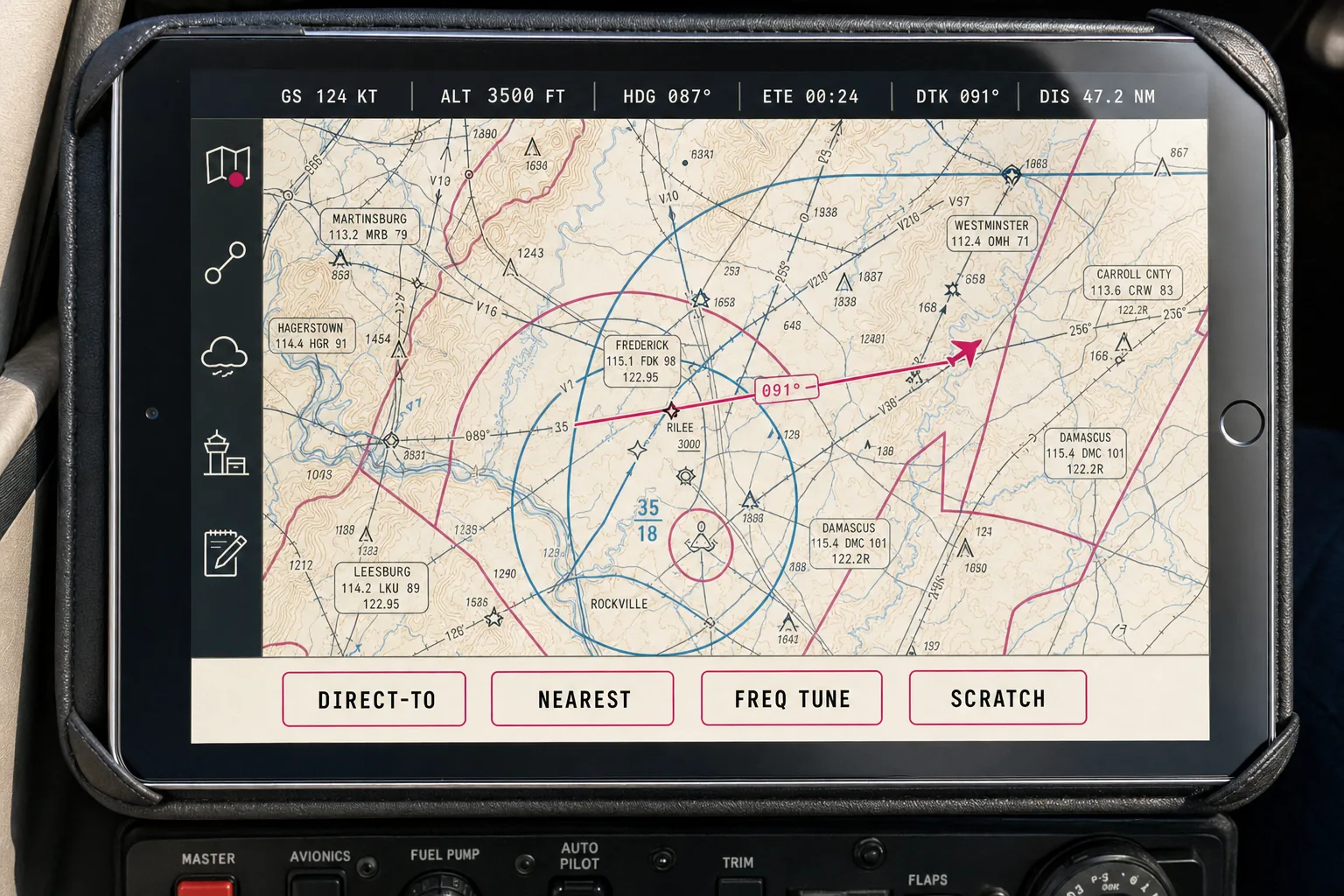
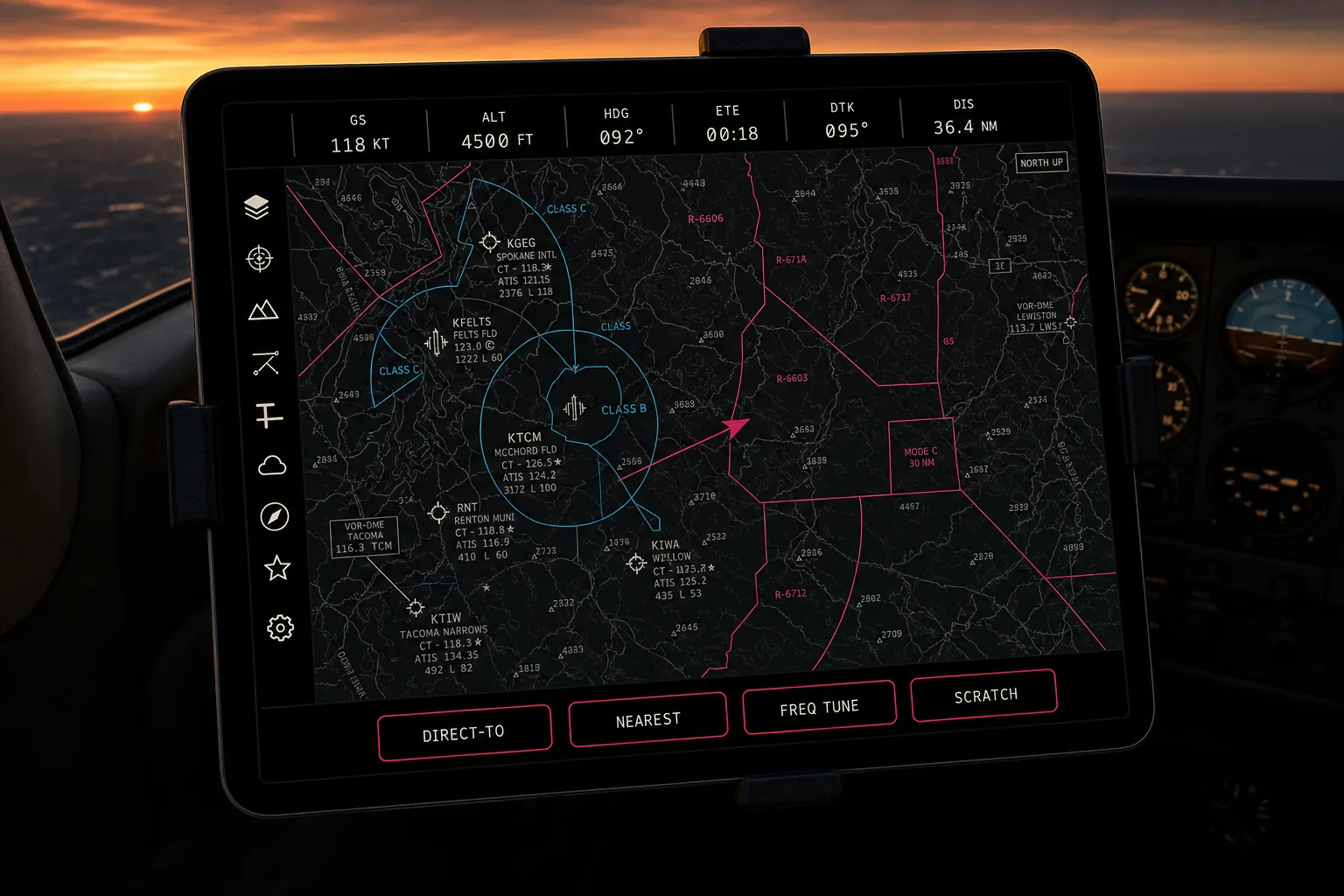
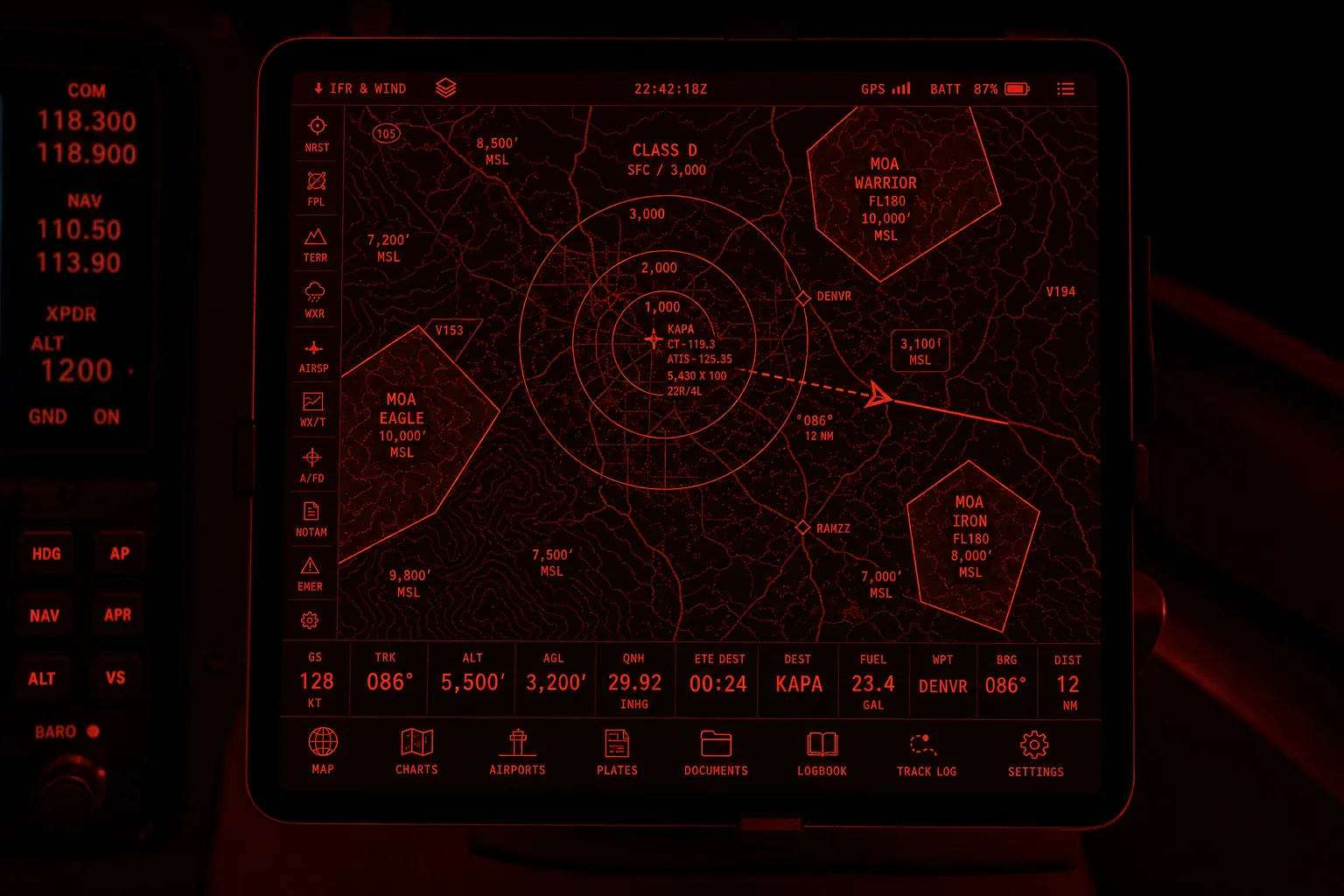
A cockpit at altitude is one of the brightest environments your eyes ever inhabit. Direct sun through a clear canopy can deliver more than 100 000 lux at the iPad's glass. Your screen, fighting back at roughly 1 000 nits, becomes more reflective than emissive — and that's the moment AMOLED dark mode quietly betrays you. White text on black turns into a mirror you can barely read.
The traditional EFB answer is to crank the brightness and squint. The right answer is to flip the contrast model. High-contrast warm paper with black ink outperforms dark mode under direct sun by a margin that's not subtle. So paper-day isn't a theme choice. It's the only mode that solves the actual problem.
The other end is harder. Night VFR depends on dark adaptation, and dark adaptation depends on starving your cones — particularly the blue-sensitive ones. Cockpit instrument backlighting has used red phosphor at 635 to 660 nanometers for half a century for exactly this reason. Our red-night mode honors that physics: a hard cap on the blue channel of every visible pixel, no animations, no glows, no gradients. The mode is an invariant, not a theme.
And in between, the dusk window — that hour when your eyes are halfway adapted, the cabin is darker than the sky, and a traditional bright-white EFB blinds you for the descent. That's what dark-dusk is for. Three modes because the cockpit has three lighting problems, and pretending it has two is how every other EFB ends up with pilots manually dimming the iPad to 5% at 1 AM.